By proceeding, I confirm that I am a financial professional (e.g., registered investment adviser, broker-dealer representative, or other qualified investment professional) and that I am accessing this content solely for informational and operational purposes. I understand that this material is intended for investment professionals only and is not directed to or intended for retail investors.
Widen the Map, Not the Credit Box: The Case for UK Bridge Lending
A market where structure, competition, and law favor the lender.
October 28, 2026
Michael Sasaki, CFA®️
Partner, Portfolio Manager
Most investors comparing private real estate debt strategies are comparing US-only managers. They look at yield, loan-to-value, duration, and track record. One question gets asked less often: where do the loans come from, and what does a manager do when that market stops producing enough loans that meet its standards?
That question is why the UK belongs in the conversation. It offers something the US market increasingly does not: a lending market with fewer competitors, no government-backed lenders setting the price, and a legal framework that gives secured lenders a clear path from collateral to recovery. For an investor, each of those features shows up in the risk inside the portfolio.
The loans themselves look familiar: short-duration, senior secured, backed by real estate, with a defined exit. What changes is the market they are made in, and that market shapes the terms an investor ends up holding.
In the UK, bridging is mainstream
In the US, bridge lending is often treated as a specialty corner of private credit. In the UK, it is an established part of property finance, with its own conventions. The average UK bridging rate in 2025 was 0.84% per month, or roughly 10.2% annualized.1
UK bridge loans are also conservatively levered. The average loan-to-value on UK bridge loans in 2025 was 55%, meaning the typical borrower had 45% of the property's value at stake ahead of the lender. For an investor in a debt strategy, that equity cushion is the first line of defense.1
A less crowded lending market
The terms an investor receives depend on how hard lenders have to compete for each loan. In crowded markets, lenders win business by stretching: higher leverage, looser covenants, tighter pricing. In the UK, two features keep that competition thinner.
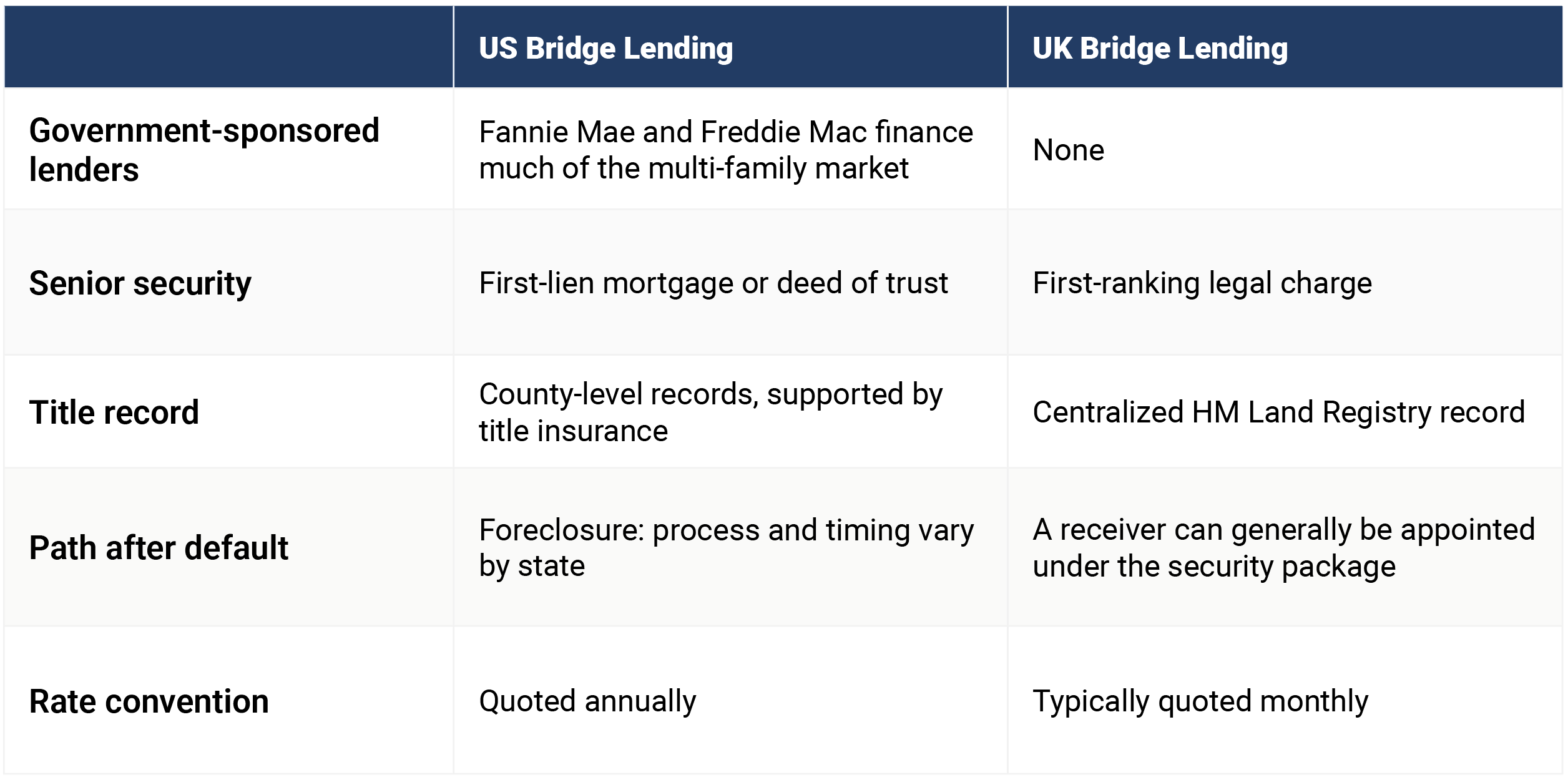
The first is what the UK does not have. In the US, government-sponsored enterprises such as Fannie Mae and Freddie Mac finance a large share of multi-family loans, supported by their relationship with the federal government. Private lenders competing for those borrowers are competing against government-supported pricing. The UK has no equivalent, so loans are priced by private capital, on private terms.
The second is that UK banks have been pulling back. New UK commercial real estate lending totaled £52.7 billion in 2025, and debt funds supplied 28% of it.1 That share reflects how much of the market banks have left to non-bank lenders.
For investors, the result matters more than the mechanics. A lender that does not have to stretch to win loans can hold its standards, and the 55% average loan-to-value above is what that looks like in practice.
A legal framework built for secured lenders
Investors evaluating any debt strategy eventually ask the same question: what happens if a loan goes wrong? In the UK, the answer can start earlier than most US investors expect, and it rests on four pieces.
A UK bridge lender typically takes a first-ranking legal charge over the property. That is the UK analogue to a US first lien: a senior secured claim on the collateral, ahead of other creditors.
That charge is recorded with HM Land Registry, a centralized record of property title and registered charges for England and Wales. In the US, title records are kept county by county, and title insurance exists in part because those records can be incomplete.
The third piece has no close US equivalent: the ability to act before a loan is delinquent. Under English law, a lender holding a legal charge has a long-standing right to take possession of the property even when no payment is outstanding, unless the loan documents limit it. In commercial lending, those documents typically define when the lender can step in, and the triggers can go well beyond a missed payment: a breach of a loan-to-value covenant, a stalled business plan, or the borrower’s insolvency. Some facilities are written so that the loan is repayable on demand.
For an investor, that changes the timing of risk. In the US, a lender often has to wait for a payment default before enforcing, then work through a foreclosure process. A UK lender can often act when the collateral or the business plan starts to deteriorate, while the borrower’s equity cushion is still in place, rather than after payments have stopped. The right is not unlimited: courts expect it to be exercised in good faith, and disciplined lenders treat it as protection, not a first resort. But having it changes the conversation with a struggling borrower.
Once the lender acts, a receiver can generally be appointed under the security package to take control of the property and manage or sell it, typically without a court process. In many US states, recovering collateral means foreclosure, and legal requirements, timelines, and procedures vary widely from state to state.
Together, the four pieces form a clear path from collateral to recovery: a senior claim, a transparent record of that claim, the ability to act early, and a direct way to enforce it. For an investor, that path is a large part of what downside protection means.
The same loan, a different market
For investors comparing strategies, the differences sit in the market around the loan, not in the loan itself.
What stays the same
Whatever market a strategy lends in, the standard for evaluating it does not change. The same four principles apply on either side of the Atlantic.
1. Short duration. Bridge and transitional loans with defined terms, so capital recycles as loans repay.
2. Real estate collateral. Asset-backed lending focused on borrower equity and downside protection.
3. A defined exit. Repayment through a sale, refinance, stabilization, or takeout financing.
4. Risk controls. Transaction-level review before any capital is deployed.
Lending in the UK also brings its own considerations. Legal processes differ, local market knowledge matters, and loans made in sterling introduce currency exposure that has to be managed. Enforcement rights only help if a loan was sized and structured correctly to begin with. Bridge loans remain credit investments, and borrower performance, collateral values, and market conditions still determine outcomes.
Questions investors should ask
When a lender's home market stops producing loans that meet its standards, it has two choices: loosen the credit box or widen the map. Loosening the box tends to show up later, in higher leverage, thinner equity cushions, and weaker sponsors. Widening the map keeps the standards and changes where the loans come from.
That makes these questions worth asking of any private real estate debt strategy, whether it lends only in the US or across markets:
1. Has the lender held its underwriting standards as deal flow changed? Look at whether average loan-to-value ratios and loan sizes have drifted over time.
2. Where does the lender go when its market can't supply enough loans that fit? Holding cash, loosening terms, and expanding into new markets are very different answers.
3. Does the strategy depend on a single market's opportunity set? Geographic concentration is a risk in its own right, even when every loan is senior and secured.
4. For lending outside the US, does the manager have local origination and legal expertise, and does it apply the same underwriting standards as it does at home?
5. How is currency exposure managed?
A strategy that can compare opportunities across markets is not reaching for yield. It is choosing where its standards can be met.
A complement, not a replacement
For most allocations, US real estate debt remains the core. The point is not that every client needs UK exposure. It is that the opportunity set behind a private real estate debt strategy matters as much as the strategy itself.
A strategy confined to one market depends on that market to keep producing loans worth making. A strategy that can compare developed markets can stay selective when one gets crowded, and put capital where structure, competition, and law line up in the lender's favor. Right now, the UK is one of those markets, and it belongs in the conversation when comparing private real estate debt strategies.
1Data as of 1/1/2026. Source: Bayes Business School, UK Commercial Real Estate Lending Survey (YE 2025), KPMG UK Financial Services Market Activity / Bridging Trends, Redwood.
The CREMX Fund invests at least 80% of its net assets in U.S. commercial real estate debt. Non-U.S. investments, expected to be primarily in the United Kingdom and Europe, are limited to the remaining portion of the portfolio, which also holds cash and short-term fixed income.
FOREIGN INVESTMENT RISK. Foreign securities may be issued and traded in foreign currencies. As a result, changes in exchange rates between foreign currencies may affect their values in U.S. dollar terms. The political, economic, and social structure of some foreign countries may be less stable and more volatile than those in the United States.
Interested in Learning More?
Have questions about CREMX, interval funds, or portfolio construction? Our team is here to help.
Thank you! Your submission has been received!
Oops! Something went wrong while submitting the form.