By proceeding, I confirm that I am a financial professional (e.g., registered investment adviser, broker-dealer representative, or other qualified investment professional) and that I am accessing this content solely for informational and operational purposes. I understand that this material is intended for investment professionals only and is not directed to or intended for retail investors.
The Redemption Wave Isn’t a Liquidity Story
When investors lose confidence in the marks, they ask for their money back. That is the actual sequence.
August 19, 2026
Steve Kirschner, CAIA®
Senior VP – National Institutions
The headlines from recent quarters have described interval funds and non-traded BDCs as if the semi-liquid wrapper had failed. Elevated redemption requests. Proration. Coverage suggesting the entire vehicle category is broken. The narrative has a shape and a name, and the name is liquidity.
The narrative is wrong about the mechanism. The vehicles have been executing the repurchase policies they have always disclosed. The five percent quarterly cap that has been in the offering documents from day one is functioning exactly as designed. What changed in this cycle is not the vehicles’ delivery of liquidity. What changed is investor demand for liquidity. And that shift traces to something more specific than a general anxiety about private markets.
Investors lost confidence in the marks.
The mechanism
An investor opens the paper or a screen and sees that a publicly traded BDC has taken a nine-figure markdown. A Reuters analysis of the publicly traded BDC universe finds that a substantial share of loans have been marked down. Independent market analysis identifies pricing gaps of tens of points between what funds are reporting as fair value and what the market is willing to pay for similar assets.
The investor does not read the offering documents. The investor reads headlines. The reasonable question forms quickly: if their funds are marking loans down that far, what are mine actually worth?
The redemption request follows. Aggregate requests at the vehicle exceed the cap. Proration kicks in. Media reports it as gates. Confidence erodes further. Investors who might have held file requests defensively. The cycle continues.
The mechanism is real. What matters is that it is a mechanism about confidence in valuations. The liquidity feature is the messenger. It is not the story.
Where the confidence broke, and why
Not every private credit strategy has the same exposure to a mark shock. The segment that has been under pressure in this cycle is identifiable: corporate middle-market direct lending, particularly loans against companies whose value depends on multiples of earnings and on the future trajectory of a sector.
The vulnerability there is structural rather than a matter of manager skill. A loan is marked against a multiple of borrower earnings and a set of assumptions about how the borrower gets refinanced or sold in the future. When earnings compress, when refinancing markets close, or when a sector such as software is disrupted by artificial intelligence, the multiple that supported the mark yesterday may not support it today. The gap between reported fair value and the market’s willingness to transact can widen quickly. Payment-in-kind income, which reached roughly eight percent of BDC interest income by industry data in 2025, can obscure the underlying cash-flow deterioration until the mark is forced to move. And when marks move at that speed, investor confidence tends to move with them.
This is not a private-credit-wide problem. It is a valuation-model problem concentrated in the part of the category where the marks sit farthest from observable cash events and closest to assumptions about the future.
What makes a mark credible
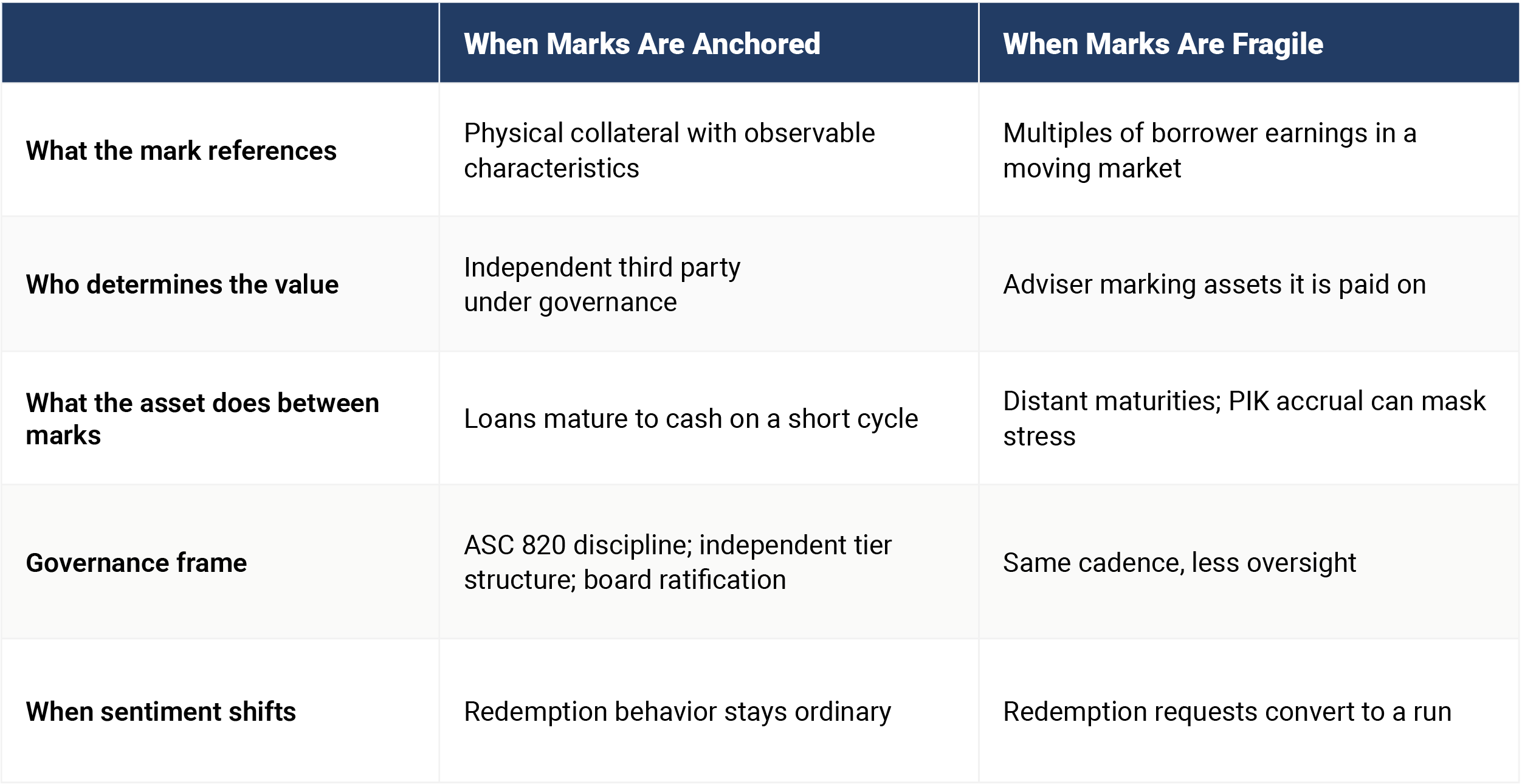
If marks drive confidence and confidence drives redemption behavior, the diligence question worth taking seriously is what makes a mark credible or fragile in the first place. Four variables do most of the work.
The first is what the mark is referencing. A mark against physical collateral is different from a mark against enterprise value. A property has a location, a use, a rent roll, and a cost to build. An enterprise has a growth trajectory and a multiple. Both can be legitimate anchoring points for a loan, but they behave differently when the market moves.
The second is who determines the value. A mark set by the fund manager that is being paid on the assets is not the same as a mark set by a third party with no economic interest in the answer. Manager marks are permitted, common, and often defensible. But they carry a structural conflict that independent third-party valuation does not.
The third is what the asset is doing between marks. A loan with a distant maturity produces no cash event to anchor the mark until years pass. A short-duration loan produces cash events regularly, and each maturity is a real-world price check on the mark that preceded it. The rate at which loans mature to par is one of the most underappreciated inputs to mark credibility.
The fourth is the governance frame. A quarterly mark is more or less credible depending on what surrounds it: the ASC 820 fair value discipline, the independence of the pricing authority, the tier structure of internal review, and the board’s role in ratifying valuations. Same cadence, different reliability.
Where marks are structurally anchored
This is where the strategy underneath a wrapper matters. A portfolio of short-duration senior first-lien commercial real estate bridge loans has structural characteristics that reduce exposure to the specific vulnerability the market has been repricing. Loans are marked against physical collateral with observable characteristics, not against multiples of borrower earnings. With a weighted-average maturity of roughly four months, currently 4.12 months as of June 30, 2026, the book is continuously maturing to cash, and each maturity is a real-world price check on the mark that preceded it. Independent quarterly valuation by Houlihan Capital, an outside firm with no economic interest in the answer, under a three-tier governance structure at ASC 820 fair value, provides additional oversight and validation of the loan valuations. Distributions have been paid entirely from net investment income, with no return of capital, so the income the fund reports is cash it has actually collected rather than accrued income of the kind that can mask cash-flow deterioration elsewhere in the category. The fund has recorded zero principal loss since inception. And a book built after the 2023 CRE reset carries a basis set against post-stress pricing rather than peak pricing.
None of this is immunity from valuation risk, and a zero-loss record to date is not a promise about the future. The point is not that a fund like this cannot mark down. It is that the marks it carries are anchored to cash events and to independent judgment, so a sentiment shock in a different segment of private credit does not automatically become a mark shock in this one. That anchoring is how a capital-preservation philosophy, the RiskFirst® approach that puts avoiding loss ahead of chasing return, shows up at the level of an individual holding.
Two lessons at once
The redemption headlines from this cycle carry two lessons that advisors are positioned to teach.
The first is that the vehicles are working. Interval fund proration and non-traded BDC redemption caps are not accidents. They are the structural features that let long-dated or illiquid assets sit inside a wrapper that offers periodic access. When those features activate under stress, they are doing their job.
The second is that the reason those features activated in this cycle is not a random surge of investor liquidity demand. It is a specific loss of confidence in specific marks in a specific segment of private credit. Advisors who can point clients to what makes their fund’s marks credible, rather than debating whether a five percent quarterly repurchase is enough, are having a materially different conversation.
The takeaway
Liquidity was the story on the surface. Underneath it, the story was valuations. When investors trust the marks, redemption behavior stays ordinary and vehicles do what they were designed to do. When investors stop trusting the marks, redemption behavior becomes a run and vehicles look like they are failing at something they are actually delivering on.
For advisors, the practical question shifts. It is not whether the wrapper offers enough liquidity. It is whether the marks inside the wrapper are anchored to something the market will still respect when sentiment turns. Ask what the marks are referencing. Ask who is setting them. Ask what the assets are doing between marks. The answers determine whether the vehicle is quietly delivering its policy or loudly delivering a headline.
Interested in Learning More?
Have questions about CREMX, interval funds, or portfolio construction? Our team is here to help.
Thank you! Your submission has been received!
Oops! Something went wrong while submitting the form.