By proceeding, I confirm that I am a financial professional (e.g., registered investment adviser, broker-dealer representative, or other qualified investment professional) and that I am accessing this content solely for informational and operational purposes. I understand that this material is intended for investment professionals only and is not directed to or intended for retail investors.
Bridge Lending Meets Higher Rates
When rates rise, the structure of a loan decides what happens to its value.
October 2, 2026
Richard Duff
Portfolio Manager, Managing Partner
On September 16, the Federal Reserve raised its target range by a quarter point to 3.75%–4.00%, its first increase since 2023. The committee's projections point to one more hike before year-end.
For advisors with clients in private real estate debt, the natural reaction is to ask whether higher rates are good or bad for the category. That question is too broad to be useful.
Private real estate debt is not one homogenous rate exposure. A seven-year, fixed-rate loan on a fully leased industrial property and a short-term, floating-rate bridge loan on an apartment building in lease-up are both real estate debt. When rates rise, they behave almost nothing alike.
Our view is straightforward. Within private real estate debt, short-duration, floating-rate bridge lending is the strategy least affected by higher rates. The reasons are structural, not cyclical. They come down to how the coupon is set, how long capital is committed, and how often the book is re-underwritten.
When the coupon is fixed, the price has to move
Consider a seven-year, fixed-rate loan on a fully leased, stabilized property. The tenants pay rent. The borrower makes every payment. The credit is performing exactly as underwritten.
Then rates rise. A new loan on a comparable property now pays more than the existing one. No buyer will pay full value for a loan earning yesterday's rate when today's rate is available. So the value of the existing loan falls until its yield matches the market.
Nothing went wrong with the property or the borrower. The loan lost value because its coupon could not move.
That is duration risk, and it grows with time. The longer the remaining term, the more years of below-market payments the loan carries, and the larger the price adjustment. For a fund holding a book of long-dated, fixed-rate loans, a rising-rate environment shows up as markdowns on loans that are paying on time.
This is not a criticism of fixed-rate lending. Locking in a coupon has a role in a portfolio. But advisors should be clear that a stable property and a stable loan value are not the same thing. The property drives the credit risk. The coupon structure drives the rate risk.
When the coupon floats, the loan holds its value
A floating-rate bridge loan is priced as a spread over a benchmark, typically SOFR. When the benchmark rises, the coupon resets with it. The loan never becomes a below-market asset, because its rate keeps pace with the market.
That is the heart of the case. With a fixed-rate loan, rates go up and the value of the loan goes down. With a floating-rate loan, rates go up, the interest rate goes up, and the value of the loan generally stays near par.
The benefit shows up in two places at once. Income on capital already deployed can rise with benchmark rates, without waiting for loans to mature and be replaced. And the mark on the loan is not pulled down by the rate move itself.
Many bridge loans also carry rate floors, which set a minimum coupon if benchmarks later fall. The structure participates when rates rise and sets a floor under income when they decline.
Longer financing, More Risk
The longer a loan runs, the more it depends on conditions no one can underwrite today. A seven- or ten-year loan has to hold up through multiple rate cycles, shifting property values, and changing appetite among lenders. At the end of it, the borrower faces a refinancing decision in a market that may look nothing like the one at origination.
Every additional year adds a variable. That is the complication built into longer-term financing: the lender is underwriting not just the property, but the future.
A bridge loan narrows those variables. It finances a specific transition, such as a lease-up, a renovation, or a repositioning, with a defined exit through a sale or permanent financing. The underwriting question is not where rates will be in 2033. It is whether this business plan works, at today's rates and today's values, over the life of the loan.
Shorter duration, less risk
Short duration does a second job beyond limiting rate sensitivity. It keeps the book current.
When bridge loans repay, principal comes back and is redeployed into new loans underwritten at current rates, current property values, and current lending terms. A portfolio that turns over on a short cycle is continuously repriced to the market it operates in.
Compare that with a long-duration portfolio originated when rates were lower. Its loans carry the assumptions of the year they were made: the rate, the valuation, the expected exit. Those assumptions stay on the books for years, whether they still hold or not.
In a higher-rate environment, the advantage compounds. New bridge loans are written with today's cost of capital built into loan sizing, reserves, and debt-service coverage. Lenders with capital to deploy can be selective. And as we noted in our post on the redemption wave, each maturity is a real-world price check on the value at which the loan was carried. A short-duration book gets that check constantly.
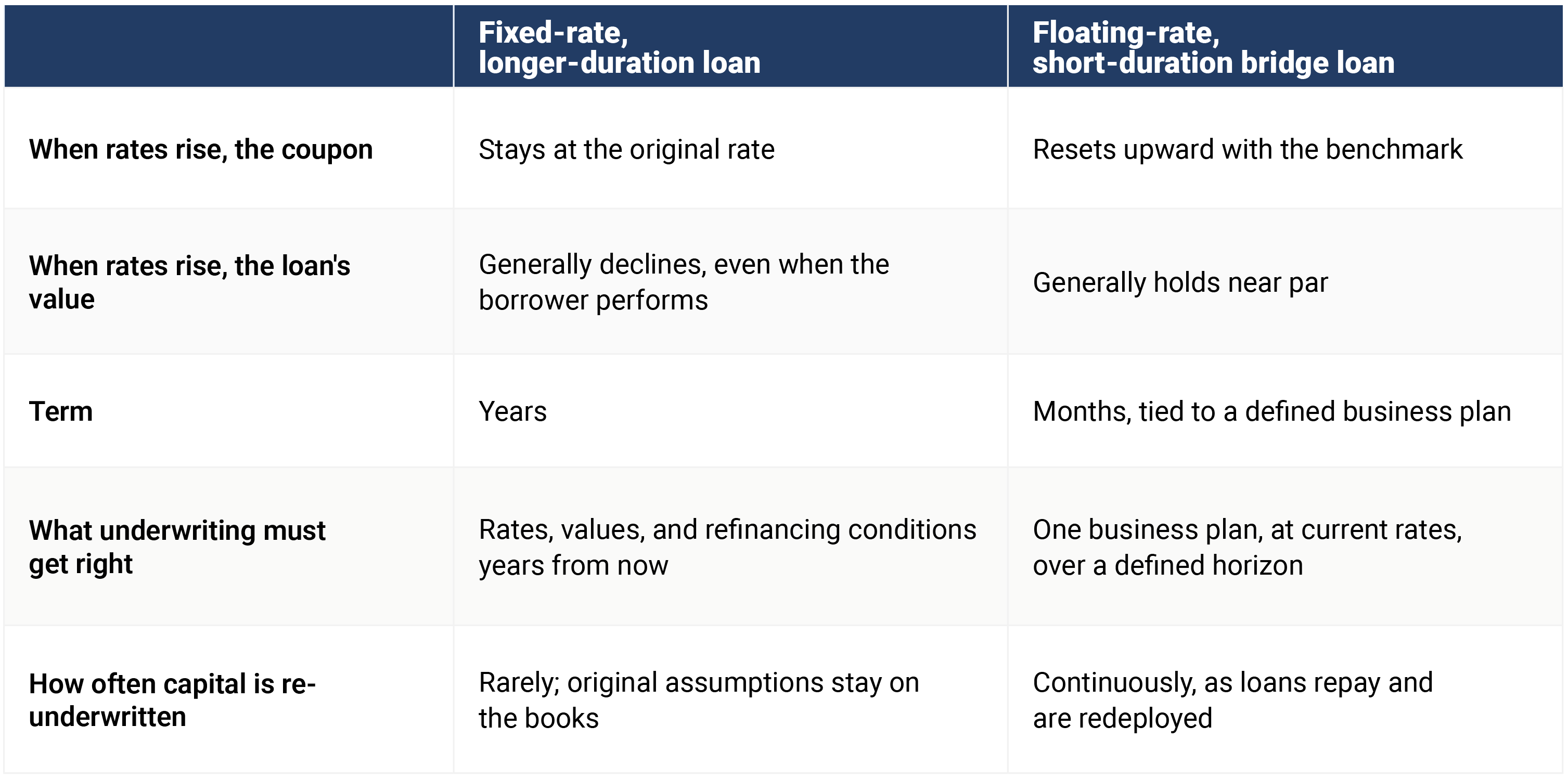
Same asset class, opposite rateexposure
Side by side, the two structures respond to a rate increase in oppositeways.
Questions advisors should ask
When comparing private real estate debt strategies in a higher-rate environment, five questions separate the structures quickly.
1. Is the coupon fixed or floating? If it floats, how often does it reset, and are there rate floors?
2. What is the portfolio's weighted-average maturity? The shorter it is, the faster the book reprices to current conditions.
3. How many loans repaid on schedule? A short-stated term matters most when loans actually pay off rather than extend.
4. When did the book originate? Loans written after rates reset carry a basis that already reflects higher financing costs.
5. Who values the loans? Independent valuation, combined with frequent maturities, gives the marks an anchor that a rate move or a headline cannot easily shake.
Structure works best with discipline underneath it
Structure explains how a loan responds to rates. Underwriting determines whether it gets repaid. Bridge loans are credit investments, and borrower performance, collateral values, and market conditions still matter. Higher rates raise the borrower's cost of carry along with the lender's income, which is why loan sizing, reserves, and sponsor strength deserve close attention at origination.
Two other distinctions belong in the client conversation. Fund-level income reflects expenses and financing costs, and floating-rate income can decline if benchmarks fall. And a short loan term is not the same as investor liquidity: in an interval fund, for example, quarterly repurchases are limited and may be prorated.
The strongest bridge lending strategies pair the structure with discipline: senior first-lien positions, conservative loan sizing, independent valuation, and a book originated at today's basis. When those come together, the rate advantage described above has something solid underneath it. That is a RiskFirst® way to approach private real estate debt: avoiding loss comes ahead of chasing return, and the structure does the work.
Structure decides the response
Higher rates sort private real estate debt by structure. Long-dated, fixed-rate exposure absorbs the move through its price. Short-duration, floating-rate bridge lending absorbs it through its coupon, and reprices the rest of the book as loans repay.
For advisors comparing strategies in this environment, the useful question is not whether the Fed will raise rates again. It is which structure keeps pace if it does. On that question, we believe bridge lending has the stronger answer.
Interested in Learning More?
Have questions about CREMX, interval funds, or portfolio construction? Our team is here to help.
Thank you! Your submission has been received!
Oops! Something went wrong while submitting the form.